

Average Cost to Build an Optometry Office in the USA (2026 Complete Guide)
Average Cost to Build an Optometry Office in the USA
What changed in optometry office construction this month
Three forces moved optometry buildout pricing in May 2026: PE-backed rollups kept consolidating market share, advanced imaging equipment became standard in mid-tier practices, and FGI Guidelines updates pushed ventilation scope on new construction.
Optometry consolidation accelerated. American Optometric Association data shows roughly 27 percent of U.S. optometry practices now operate under PE-backed rollups (MyEyeDr, EyeCare Partners, Vision Source-affiliated groups, Clarkson Eyecare), up from 19 percent two years ago. The construction implication is real: rollup-driven prototype standardization is pulling per-square-foot costs down 8 to 15 percent at scale, and independent ODs need to match that discipline through design-build delivery and prototype repetition to compete on capital efficiency.
OCT, fundus photography, and visual field analyzers moved from premium to standard equipment in mid-tier practices. The construction impact is electrical and HVAC scope. Each advanced imaging room needs dedicated 20A circuits, isolated grounding, calibrated lighting controls, and tighter temperature stability than general exam space. Commercial electrical cost per square foot on optometry TI work has risen 6 to 9 percent since Q1 2026.
FGI 2022 Guidelines for Design and Construction of Outpatient Facilities were adopted as code in eight additional states this spring, pushing ASHRAE 170 ventilation requirements onto more optometry projects. The cost impact is $4 to $11 per GSF on new construction and a roughly 4 to 8 week schedule add for AHJ review on TI work in newly-adopting jurisdictions. Confirm code adoption with the AHJ before pricing.
One cost driver moved down: dispensary and frame-display millwork lead times normalized to 8 to 12 weeks after the 2025 backlog. Material lead times across optometry-relevant scopes (custom millwork, ophthalmic flooring, calibrated lighting fixtures) are now manageable for fast-track schedules.
Optometry office construction cost per square foot (May 2026)
Per-gross-square-foot ranges from TCG preconstruction data, cross-checked against RSMeans 2026 healthcare data and CBRE Medical Office MarketView. Hard cost only on tenant improvement in average shell condition. Add soft costs, equipment, and contingency separately.
Solo OD, 2 to 3 exam lanes
1,500 to 2,500 SF total. Modest dispensary, no in-office lab, standard diagnostic equipment. The most common new-practice format for residency graduates and first-time owners.
2 to 3 ODs, 3 to 5 exam lanes
2,500 to 4,000 SF total. Full dispensary with frame inventory, contact lens fitting room, pre-test room with autorefractor and tonometer, dedicated billing area.
4 to 6 ODs, 5 to 8 exam lanes
4,000 to 7,000 SF total. In-office optical lab (edging, tracing, mounting), specialty imaging room, multiple pre-test stations, expanded dispensary, vision therapy room.
Combined ophthalmology and optometry
7,000+ SF. Surgical suite, laser room with shielding, OCT room, B-scan ultrasound, full medical gas, NFPA 99 compliance, ASHRAE 170 ventilation, ASCs may push higher.
Vision-plan-driven retail format
Inside larger retail (mall, big-box, vision insurance plan storefront). Smaller exam footprint, larger frame display. Brand-standard prototypes drive cost more than scope.
Vision van and limited-scope locations
Limited-scope satellite locations, often in second-tier retail or community health settings. Usually 1 to 2 exam lanes, no in-office lab, minimal dispensary inventory.
Specialized pediatric optometry
Lower-height millwork, kid-friendly finishes, vision therapy room, separate quiet exam space, expanded play area, sound isolation. Premium for specialty fit-out.
Retail or office to optometry
Existing retail or office shell with adequate clear height, parking, and MEP capacity. Demolition, partition framing, MEP rework, and ADA upgrades drive the cost band.
What an exam lane actually costs to build
Exam lanes are the unit economics of optometry construction. Each lane carries a discrete cost band for buildout and another for clinical equipment. Plan both line items separately when underwriting the project.
Lane Construction
Demising walls with sound rating, calibrated lighting controls, dedicated electrical, hand wash sink with rough-in, network and AV cabling, exam chair backing, millwork at exam stand.
Lane Clinical Equipment
Phoropter ($7K to $15K), slit lamp ($8K to $20K), exam chair ($4K to $12K), exam stand ($3K to $8K), tonometer or autorefractor in lane ($5K to $15K), computer and instrument table.
Pre-Test Room
Autorefractor, NCT tonometer, visual field, room equipment ($30K to $80K equipment separately). Shared by multiple lanes. Sound isolation and calibrated lighting required.
Imaging Room (OCT, Fundus)
Dedicated electrical, isolated ground, dimmable lighting, tighter temperature stability, sound isolation. Equipment runs $50K to $200K separately (OCT, fundus camera, topographer).
Optical Dispensary
Custom frame display millwork, calibrated lighting on frames, dedicated counter at adjustments, computer station, frame inventory storage. Premium driver: brand standards and lighting.
In-Office Optical Lab
Edging machine, tracing machine, lensometer, layout tools, blocking tools, edging consumables. Buildout adds $25,000 to $60,000 for plumbing, electrical, exhaust, and millwork.
Per-lane underwriting math
For a 5-lane standard practice in a 3,200 GSF tenant improvement: lane construction $200,000 to $375,000, pre-test and imaging rooms $70,000 to $145,000, dispensary buildout (1,000 SF at $180 per SF) $180,000, common areas and finishes $400,000 to $700,000. Hard cost lands $850,000 to $1,400,000. Add $400,000 to $900,000 in clinical equipment, $200,000 to $400,000 in soft costs and FF&E. All-in project cost typically $1.45M to $2.7M for a 5-lane standard buildout.
Standard optometry office cost by region
National averages obscure a 50+ percent regional spread. The bars below show TCG May 2026 benchmarks for standard 3-to-5-lane optometry tenant improvement across nine major regions, as a percentage of the national high end.
The spread reflects labor cost, prevailing wage exposure, code stringency (especially seismic in California and energy code in NY and MA), AHJ medical occupancy review, and impact fees. State-level permitting timeline data tracks the regional cost premium closely. Healthcare occupancy review adds 4 to 12 weeks beyond standard commercial timelines in most jurisdictions.
Tenant improvement vs ground-up for optometry
Most new optometry practices are tenant improvement projects in retail centers, medical office buildings, or adaptive reuse spaces. The question is when ground-up makes financial sense.
Optometry tenant improvement runs roughly 60 to 75 percent of ground-up cost when the shell delivers white box or vanilla shell condition. The savings come from existing structural shell, foundation, slab, envelope, and core MEP infrastructure. Commercial tenant improvement cost benchmarks apply directly to optometry, with healthcare-specific premiums on ASHRAE 170 ventilation, sound-rated walls, and dedicated electrical service.
Ground-up makes sense in three scenarios. First, when the practice owner is buying the real estate and amortizing through SBA 504 financing, a purpose-built building outperforms TI on lifecycle cost. Second, in markets where suitable shells do not exist or are priced at a premium that erodes the TI savings (most coastal core markets in 2026). Third, when MD-OD or surgical scope requires custom structural, MEP, and shielding that retrofitting an existing shell would cost more than building new.
The hybrid that wins most often: ground-up shell for an MOB anchor with an optometry practice as the lead tenant, where the optometry owner contributes to shell cost in exchange for a long-term lease that amortizes the contribution over the term. SBA 504 financing works in either format and is the dominant capital stack for owner-operator optometrists building a single location.
The TCG decision rule on TI vs ground-up
For a 5-lane standard practice on leased space in a Class B retail center, choose tenant improvement and negotiate an aggressive TI allowance ($40 to $80 per SF for medical-credit-quality tenants on a 10-year term). For an owner-operator wanting to build equity through real estate, choose ground-up on a 5,000 to 7,000 SF MOB shell with an optometry-anchor TI inside, financed through SBA 504 with 10 percent down.
Get a defensible optometry build budget in under five minutes
Run TCG's AI estimator for any practice size. Upload landlord shell drawings for instant scope pricing. Or book a 30-minute preconstruction call with a partner.
From hard cost to all-in project cost
Optometry hard cost is the headline number. Total project cost is what gets financed. Soft costs and clinical equipment add 35 to 60 percent over hard cost on a typical practice.
Soft costs run 12 to 18 percent of hard cost on optometry projects, higher than retail because medical occupancy review, FGI compliance, and ASHRAE 170 commissioning add design and engineering scope. Architectural and engineering fees account for 7 to 11 percent. Permits and AHJ review absorb 2 to 4 percent. Financing, legal, and insurance run 2 to 5 percent. Construction loan draw schedules dictate when those costs hit cash flow.
Clinical equipment is the single largest line item outside construction. A 5-lane practice typically carries $400,000 to $900,000 in clinical equipment (lane equipment, OCT, visual field, fundus camera, autorefractor, optical lab equipment) plus $80,000 to $250,000 in dispensary inventory, fixtures, and IT. GC-led equipment procurement can compress timing and capture 6 to 12 percent savings on optical lab and lighting packages.
Practice management software, EHR, and integrated optical platforms add $40,000 to $120,000 in capitalized cost depending on selection. Marketing and grand-opening cost commonly runs $25,000 to $80,000 and is often absorbed into working capital rather than capitalized. SBA 504 typically caps at total project cost (real estate + construction + equipment) under $5.5M.
Total project cost rule of thumb (May 2026)
For a 3,200 GSF, 5-lane standard optometry tenant improvement in a typical Sun Belt suburban market: hard cost $850,000 to $1,400,000, soft cost $130,000 to $210,000, clinical equipment $400,000 to $900,000, FF&E and IT $80,000 to $200,000, opening working capital $80,000 to $150,000. All-in project cost $1.55M to $2.85M, or roughly $485 to $890 per gross square foot delivered including equipment.
The five planning mistakes that blow optometry budgets
1. Designing too few exam lanes. A 3-lane practice that grows to need 5 lanes within 3 years pays the construction premium twice. Underwrite for capacity 36 to 60 months out and rough-in MEP and partitions for the future lanes during initial construction. The marginal cost to rough-in a future lane during base construction is roughly 25 percent of the cost to add it later.
2. Skipping the GC during lease negotiation. Nine of ten optometry tenant improvements are designed over budget because the GC is not involved until after lease signing. Bring the GC into preconstruction at LOI stage to negotiate shell delivery condition and TI allowance against real numbers, not back-of-envelope estimates.
3. Cheap MEP in a medical occupancy. Saving $8 per SF on HVAC by using standard rooftop equipment instead of ASHRAE 170-compliant systems creates code-violation risk on imaging and pre-test rooms, plus failed final inspections. Specify healthcare-grade HVAC from schematic design and budget the proper mechanical scope.
4. Generic exam lane lighting. Optometry exam lanes require calibrated, dimmable lighting (3000K to 4000K, CRI 90+, dimming to 1 percent) for accurate vision testing. Cheap dimmer-and-LED packages create exam variance and clinical complaints. Specify IES-compliant healthcare luminaires at lane positions and dispensary frame display.
5. Underestimating dispensary millwork lead times and brand standards. Custom frame displays, anti-theft fixtures, and brand-standard finishes drive 25 to 40 percent of dispensary cost. Lock millwork specifications and place orders at 70 percent design development, not at construction documents, or risk a 6 to 10 week schedule overrun.
Advantage Eye Care, Owensboro, KY
TCG delivered a 5,500 SF design-build tenant improvement for a full optometry practice in Owensboro, Kentucky, taking the space from shell to patient-ready under one contract, with architectural design, MEP coordination, and construction handled by one team.
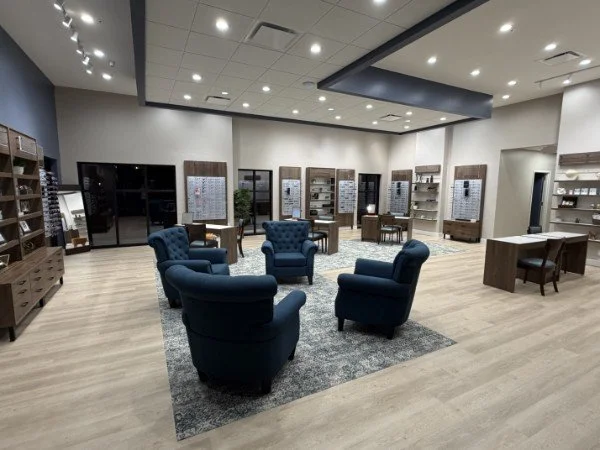
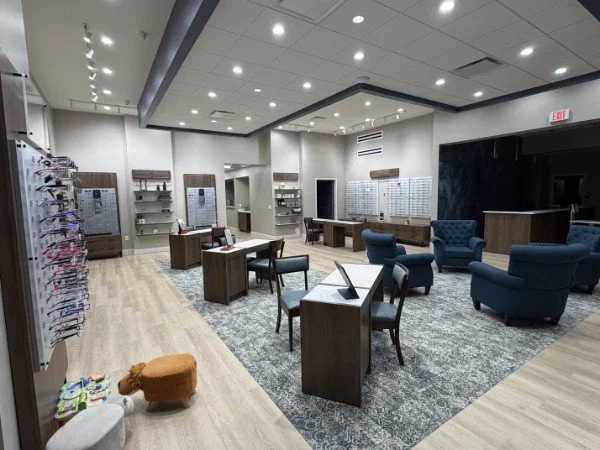
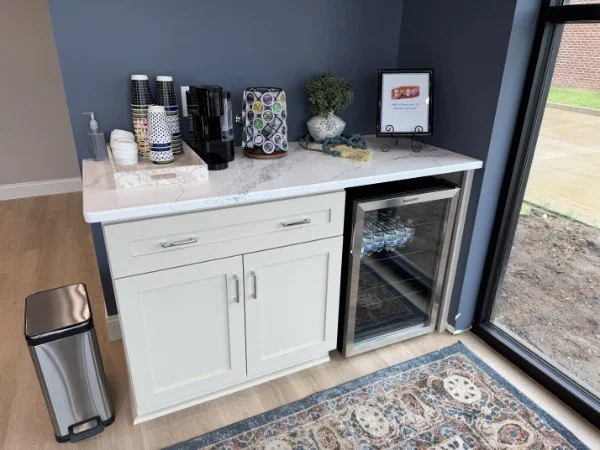
Clinical tenant improvements live or die on coordination: exam lanes built to sight-line and lighting-control requirements, a pre-testing suite, an optical dispensary with fitting stations, and a minor procedure room, all finished to a retail-grade patient experience with custom millwork throughout.
An optometry buildout in practice: the exam lanes, pre-testing suite, and optical dispensary priced in this guide are the same rooms this project delivered, under one design-build contract from shell to patient-ready. See TCG’s medical office construction and design-build services.
- Delivery: design-build tenant improvement
- Clinical: exam lanes, pre-testing suite, minor procedure room
- Retail: optical dispensary and patient lounge
- Finish: custom millwork and casework throughout
See all recent work on the TCG projects page.
Optometry office construction cost FAQ
In May 2026, building an optometry office costs $250 to $400 per GSF for a small 1,500 to 2,500 SF practice, $275 to $475 per GSF for a standard 2,500 to 4,000 SF practice with 3 to 5 exam lanes, $375 to $575 per GSF for a larger 4,000 to 7,000 SF practice with optical lab, and $475 to $750 per GSF for a multi-specialty MD-OD office. Tenant improvement runs 60 to 75 percent of ground-up. Equipment is budgeted separately.
A premium MD-OD multi-specialty office costs roughly 50 to 90 percent more per GSF than a standard optometry practice. The premium pays for surgical suites, advanced imaging rooms with shielding, dedicated medical gas, larger electrical service, NFPA 99 healthcare compliance, and tighter ASHRAE 170 ventilation. Standard optometry runs $275 to $475 per GSF; MD-OD runs $475 to $750 per GSF.
Each exam lane costs approximately $35,000 to $75,000 in construction (millwork, dedicated electrical, calibrated lighting, hand wash sink, sound isolation, AV) before clinical equipment. Add $40,000 to $120,000 per lane for clinical equipment (phoropter, slit lamp, autorefractor, exam chair, computer). Total all-in per lane runs $75,000 to $195,000.
Yes. Optometry tenant improvement runs 60 to 75 percent of ground-up cost when the shell delivers white box or vanilla shell condition. The savings come from existing structural shell, foundation, envelope, and core MEP. Costs that do not shrink: exam lane buildout, dispensary millwork, dedicated electrical for equipment, sound-rated walls, ASHRAE 170 ventilation upgrades, and ADA compliance.
A standard optometry tenant improvement runs 14 to 22 weeks from permit to certificate of occupancy. Ground-up construction runs 9 to 14 months including site work and shell. Permitting often adds 6 to 16 weeks upstream because medical occupancy review is more rigorous than retail. Design-build delivery compresses both phases by 15 to 25 percent.
Clinical equipment runs $40,000 to $120,000 per exam lane plus $80,000 to $300,000 for shared diagnostic equipment (OCT, visual field, fundus camera, topographer, autorefractor) plus $50,000 to $150,000 for an in-office optical lab. Total equipment for a 5-lane practice typically runs $400,000 to $900,000, separate from construction.
Optometry offices are typically classified as B-occupancy under IBC 2024, but advanced imaging or surgical scope can push to I-2. Code drivers include FGI Guidelines for Outpatient Facilities, ASHRAE 170 healthcare ventilation, NFPA 99 if anesthesia or medical gas is used, ADA Title III, OSHA bloodborne pathogen standards, and HIPAA acoustic privacy. Local AHJ may add radiation shielding for fundus imaging or ophthalmic ultrasound.
Private-equity-backed optometry groups (MyEyeDr, EyeCare Partners, Vision Source-affiliated) standardize prototypes across all locations, pre-negotiate equipment vendor packages, lock master service agreements with national GCs, and run tighter schedules. Cost savings of 8 to 15 percent come from procurement leverage and design repetition. Independent ODs can capture similar economics through prototype design and design-build delivery.
References (May 2026)
- American Optometric Association - Practice Research
- American Academy of Optometry
- The Vision Council Research
- FGI Guidelines for Design and Construction of Outpatient Facilities
- ASHE - American Society for Health Care Engineering
- ICC International Building Code 2024
- ASHRAE 170 Ventilation of Health Care Facilities
- NFPA 99 Health Care Facilities Code
- DOJ ADA Title III Standards
- OSHA Healthcare Industry Standards
- CDC Infection Control Guidelines
- Gordian / RSMeans Building Construction Costs 2026
- ENR Construction Cost Index - May 2026
- AIA Architecture Billings Index
- AGC Construction Inflation Alert Q2 2026
- CBRE U.S. Medical Office MarketView
- JLL Healthcare Real Estate Outlook
- Healthcare Design Magazine
- Illuminating Engineering Society Healthcare Lighting
- SBA 504 Loan Program
- Construction Dive - Industry News
